

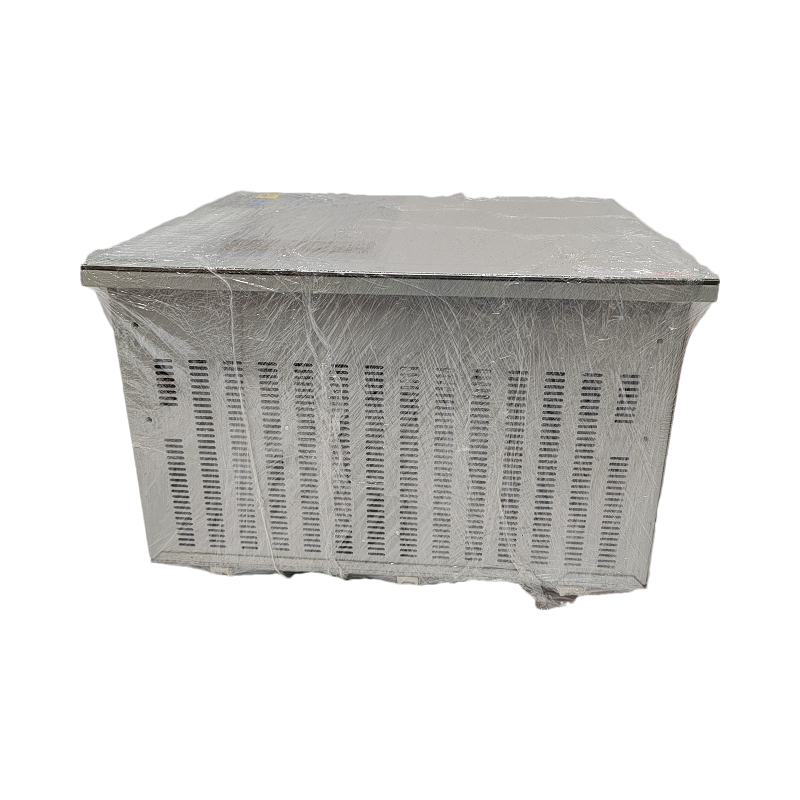
- Communication Interfaces:
- Comes with multiple communication ports. It typically has Ethernet ports for high – speed data transfer in modern industrial networks. This allows for easy connection to Supervisory Control and Data Acquisition (SCADA) systems, enabling remote monitoring and control.
- There are also serial ports, such as RS – 485, which can be used for communication with legacy devices or other field – level instruments that rely on serial communication protocols.
- Input/Output Capabilities:
- Offers a variety of input and output options. Digital inputs can detect binary states of external devices, like the on/off status of switches or sensors. Analog inputs can measure continuous physical quantities such as voltage, current, temperature, etc., with high precision.
- Digital outputs can be used to control relays, solenoids, or other binary – controlled devices. Analog outputs can adjust variables like motor speed or valve position based on the control algorithms.
Function Features
- Advanced Control Algorithms:
- Implements a wide range of control algorithms, including PID (Proportional – Integral – Derivative) control. This is crucial for maintaining stable process variables in industrial applications. For example, in a temperature – controlled process, the PID algorithm can adjust the heating or cooling system to keep the temperature at the set – point.
- It also supports more complex control strategies like fuzzy logic control, which can handle non – linear systems and uncertainties more effectively than traditional PID control in some cases.
- Self – Diagnosis and Monitoring:
- Has built – in self – diagnosis functions. It can continuously monitor its own operating status, such as the health of the processor, memory usage, and communication link integrity. In case of any malfunctions, it can quickly detect the problem and generate alarm signals.
- This helps in proactive maintenance, reducing downtime as operators can address issues before they lead to system failures.
Application Scenarios
- Industrial Automation:
- Widely used in factory automation settings. For example, in a manufacturing plant, it can be used to control conveyor belts, robotic arms, and other production equipment. It coordinates the operation of different machines to ensure smooth production flow.
- Power Systems:
- In power generation, transmission, and distribution systems, the PM866 can be used for control and monitoring. It can regulate voltage levels, control circuit breakers, and monitor power quality parameters to ensure the reliable operation of the power grid.
- Building Automation:
- Applies to building management systems. It can control heating, ventilation, and air – conditioning (HVAC) systems, lighting systems, and elevator operations. By integrating these systems, it helps to optimize energy consumption and improve the comfort level of building occupants.
Expandability
- Modular Design:
- The PM866 has a modular design, which allows for easy expansion. Additional I/O modules can be added to increase the number of input and output channels. For example, if a new production line is added in a factory and more sensors and actuators need to be connected, extra I/O modules can be simply plugged in.
- Software – Based Expansion:
- Its software is designed to be flexible, enabling the addition of new control functions. New control algorithms or communication protocols can be uploaded to the device, expanding its capabilities without the need for major hardware changes. This makes it suitable for evolving industrial requirements.
Discover our other products
Sieb & Meyer 26.45.0031.2
SIEB & MEYER 26.36.15
SIEB&MEYER 50.06.203A
SIEB &AM 151535
SIEB & MEYER 05006104
SIEB & MEYER AG 0610520IF120043A
SIEB & MEYER 26.44.0016.2
Sieb & Meyer 26.36.2
Sieb-Meyer – 0362143EC
Sieb & Meyer 26.44.0010.6

There are no reviews yet.