

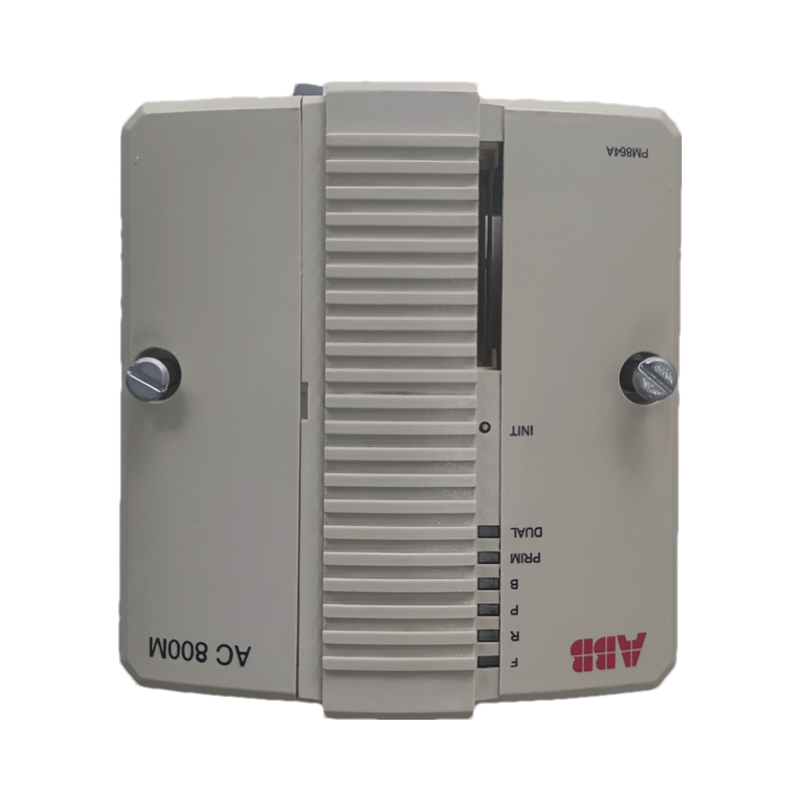
- Input/Output Capabilities
- Supports a wide range of analog and digital I/O signals. For analog inputs, it can handle signals in the range of ±10 V and 0 – 20 mA with a resolution of 16 bits. Digital inputs can detect 24 VDC signals, and digital outputs can drive loads up to 2 A at 250 VAC or 30 VDC.
- Has a high – speed sampling rate for analog inputs, up to 100 samples per second per channel, which is crucial for applications that require real – time monitoring of dynamic processes.
- Communication Interfaces
- Features Ethernet ports for high – speed data transfer, enabling seamless connection to plant – wide networks. The Ethernet interface supports 10/100 Mbps auto – negotiation, ensuring compatibility with different network setups.
- Also includes serial communication ports (RS – 485), which can be used for connecting to legacy devices or for simple point – to – point communication.
- Power Supply
- Operates on a wide – range power supply of 85 – 264 VAC or 24 – 48 VDC. This flexibility makes it suitable for use in various industrial environments with different power availability.
Function Features
- Control Logic Execution
- Can execute complex control algorithms, including PID control, sequential control, and fuzzy logic control. The built – in function blocks make it easy to configure and implement these control strategies without extensive programming knowledge.
- Supports ladder logic, function block diagram (FBD), and structured text (ST) programming languages, providing flexibility for engineers with different programming backgrounds.
- Diagnostic and Monitoring
- Has comprehensive self – diagnostic capabilities. It can monitor its own health status, including processor performance, memory usage, and communication link integrity. In case of any faults, it can generate detailed diagnostic messages, which are useful for quick troubleshooting.
- Monitors connected devices in real – time, detecting any abnormal behavior such as sensor failures or actuator malfunctions.
- Data Logging and Archiving
- Capable of logging process data at regular intervals. Data can be stored locally in its internal memory or transferred to an external storage device or a database server for long – term archiving. This is useful for trend analysis, performance evaluation, and regulatory compliance.
Application Scenarios
- Industrial Automation
- Used in manufacturing plants for controlling production lines. It can manage the operation of conveyor belts, robotic arms, and assembly machines, ensuring smooth and efficient production processes.
- In chemical plants, it controls and monitors chemical reactions, regulating parameters such as temperature, pressure, and flow rate to ensure product quality and safety.
- Building Automation
- Manages heating, ventilation, and air – conditioning (HVAC) systems in large buildings. It can adjust the temperature, humidity, and air flow based on occupancy sensors and predefined setpoints, improving energy efficiency and comfort.
- Controls lighting systems, enabling automatic on – off operation based on daylight sensors or time schedules.
- Power Generation and Distribution
- Monitors and controls power generation equipment such as generators, turbines, and transformers. It can regulate power output, detect faults, and ensure grid – connected operation in power plants.
- In electrical substations, it manages the distribution of electricity, controlling circuit breakers and monitoring electrical parameters such as voltage and current.
Supported Industrial Protocols
- Modbus
- Supports Modbus RTU over serial communication (RS – 485) and Modbus TCP over Ethernet. This allows seamless communication with a wide range of Modbus – enabled devices, such as sensors, actuators, and other controllers.
- Profibus DP
- Compatible with Profibus DP, enabling connection to a large number of Profibus – compliant devices in industrial networks. It can act as a master or a slave in Profibus DP networks, facilitating data exchange and device control.
- Ethernet/IP
- Supports Ethernet/IP protocol, which is widely used in industrial automation for its high – speed data transfer and interoperability. It can communicate with other Ethernet/IP – enabled devices, such as programmable logic controllers (PLCs), human – machine interfaces (HMIs), and intelligent devices.
Expandability
- I/O Expansion
- The PM866 has expansion slots that can be used to connect additional I/O modules. This allows the system to be easily scaled up or down depending on the number of input and output signals required for a particular application. For example, if more analog inputs are needed for a process monitoring task, additional analog input modules can be added.
- Function Expansion
- Can be enhanced with optional software packages. These packages can add new control algorithms, communication protocols, or data processing functions. For instance, an advanced analytics software package can be installed to perform more in – depth data analysis on the collected process data.
- Network Expansion
- As it supports multiple communication protocols, it can be integrated into larger industrial networks. It can communicate with other controllers, servers, and devices in a hierarchical or distributed control system, enabling the expansion of the overall control and monitoring infrastructure.
Discover our other products
GE M2LRZ
GE 25998
GE 8500
GE 712-1024
GE MISP-2R-T20
GE M27R
GE 36DL
GE 95C2001
GE GF868
Ol ympus ILP-1
GE EHC-09

There are no reviews yet.